Biological containment cabinets — the fume hood's clean cousin
Biosafety Cabinets
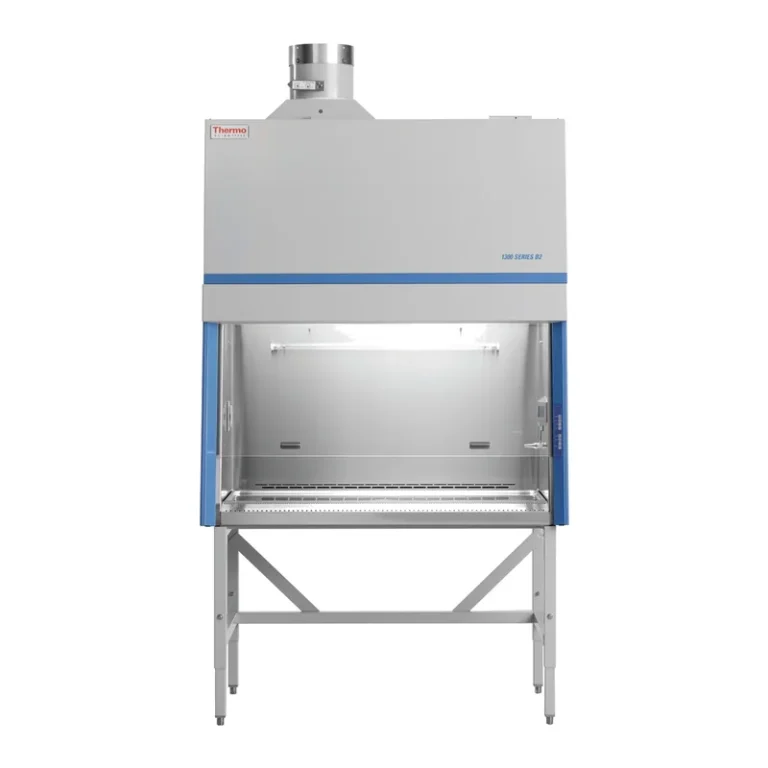
A biosafety cabinet (BSC) looks like a fume hood and sits where a fume hood sits — but it answers a different question. A fume hood protects you from chemicals with bulk airflow exhausted outdoors; a biosafety cabinet protects you, your sample and the environment from biological agents with HEPA-filtered, laminar-flow air, recirculated or exhausted through double filtration. The two are related, often adjacent in the laboratory — and never interchangeable. Classes tell the story. Class I gives personnel and environmental protection on an open front. Class II — the workhorse, in A2 and B2 configurations — adds product protection with a laminar downflow of HEPA-filtered air, for cell culture, clinical handling and sterile work. Class III seals the process entirely behind gloves. All are built to NSF/ANSI 49 design practice. WSHLAB's biosafety cabinet range runs the classes from a compact Class I to a full Class III glove box. Browse the range below; for chemical fume work, return to the fume hood pages — for biological agents, you are in the right place.
- 11Products
- 0Direct categories
- Technical support
-
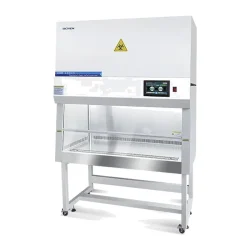
A2 Standard Biosafety Cabinet
- Airflow class
- Class II Type A2 — 30% exhausted, 70% recirculated
- Downflow velocity
- 0.33 ± 0.025 m/s
- Inflow velocity
- 0.53 ± 0.025 m/s
- Filter
- ULPA U15, 99.9995% at 0.12 µm, supply and exhaust
Price on request -
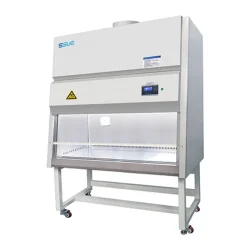
A2 Advanced Biosafety Cabinet
- Airflow class
- Class II Type A2 — 30% exhausted, 70% recirculated
- Downflow velocity
- 0.33 ± 0.025 m/s
- Inflow velocity
- 0.53 ± 0.025 m/s at the tested sash height
- Sash opening
- 12 in / 305 mm standard; 14 in / 356 mm on the 6 ft model
Price on request -
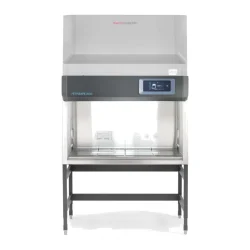
A2 Premium Biosafety Cabinet
- Airflow class
- Class II Type A2 — 30% exhausted, 70% recirculated
- Downflow velocity
- 0.33 ± 0.025 m/s
- Inflow velocity
- 0.53 ± 0.025 m/s
- Control
- Pressure sensor, digital display, alarm history, BMS dry contacts
Price on request -
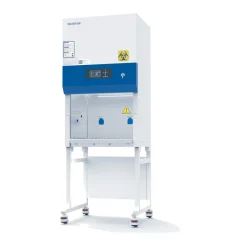
A2 Compact Biosafety Cabinet
- Airflow class
- Class II Type A2 — 30% exhausted, 70% recirculated
- Downflow velocity
- 0.33 ± 0.025 m/s
- Inflow velocity
- 0.53 ± 0.025 m/s
- Filter
- ULPA U15, 99.9995% at 0.12 µm
Price on request -
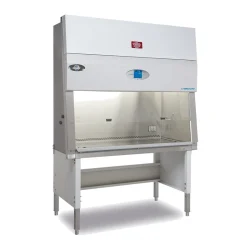
A2 Floor-Standing Biosafety Cabinet
- Airflow class
- Class II Type A2 — 30% exhausted, 70% recirculated
- Downflow velocity
- 0.33 ± 0.025 m/s
- Inflow velocity
- 0.53 ± 0.025 m/s
- Sash operation
- Manual (GL) or motorised (HA)
Price on request -
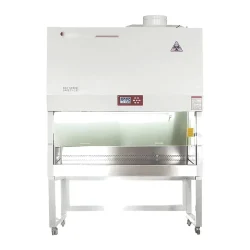
B2 Total Exhaust Biosafety Cabinet
- Airflow class
- Class II Type B2 — 100% exhaust, no recirculation
- Downflow velocity
- 0.33 ± 0.025 m/s
- Inflow velocity
- 0.53 ± 0.025 m/s
- Exhaust volume
- 1200 m³/h (4 ft) to 1900 m³/h (6 ft)
Price on request -
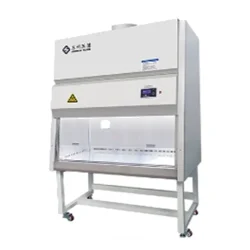
B2 Compact Biosafety Cabinet
- Airflow class
- Class II Type B2 — 100% exhaust, no recirculation
- Downflow velocity
- 0.33 ± 0.025 m/s
- Inflow velocity
- 0.53 ± 0.025 m/s
- Exhaust volume
- 1400-1900 m³/h depending on width
Price on request -
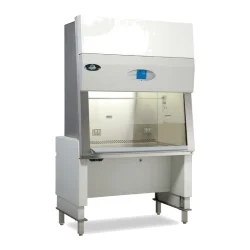
B2 Floor-Standing Biosafety Cabinet
- Airflow class
- Class II Type B2 — 100% exhaust, no recirculation
- Downflow velocity
- 0.33 ± 0.025 m/s
- Inflow velocity
- 0.53 ± 0.025 m/s
- Exhaust volume
- 1400 m³/h
Price on request -
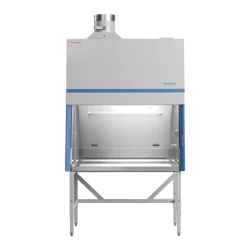
C1 Convertible Biosafety Cabinet
- Airflow class
- Class II Type C1 — convertible A2 / B2
- Modes
- A2: 30% exhaust, 70% recirculation; B2: 100% exhaust
- Downflow velocity
- 0.33 ± 0.025 m/s
- Inflow velocity
- 0.53 ± 0.025 m/s
Price on request -
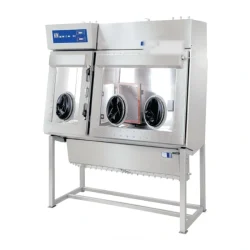
Class III Biosafety Glovebox
- Containment class
- Class III gas-tight glovebox
- Working widths
- 1100 mm, 1500 mm
- External dimensions
- 1540-1790 × 880 × 2000-2080 mm (W × D × H)
- Internal dimensions
- 910-1165 × 650 × 660 mm (W × D × H)
Price on request -
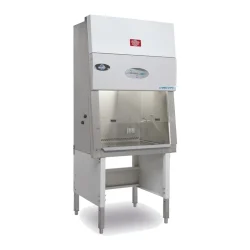
Class I Biosafety Cabinet
- Airflow class
- Class I — open front, single-pass, 100% exhaust
- Inflow velocity
- 0.7 m/s (EN 12469) / 0.38 m/s minimum (NSF/ANSI 49)
- Filter
- HEPA H14, 99.995% at MPPS, exhaust path
- Working widths
- 3 ft / 0.9 m, 4 ft / 1.2 m
Price on request
TECHNICAL DATA
Engineering the BSC range
The range runs Class I through Class III on HEPA-centred engineering: sealed plenums, stainless work zones, motorised blowers holding inflow and downflow velocities, and dual HEPA stages on any exhaust path. A2 models recirculate 70% with a 30% filtered exhaust; B2 models exhaust fully; Class III runs negative pressure behind a gas-tight barrier with interlocked transfer chambers.
Biosafety Cabinets
View ProductClass I Biosafety Cabinet
- Airflow class
- Class I — open front, single-pass, 100% exhaust
- Inflow velocity
- 0.7 m/s (EN 12469) / 0.38 m/s minimum (NSF/ANSI 49)
- Filter
- HEPA H14, 99.995% at MPPS, exhaust path
- Working widths
- 3 ft / 0.9 m, 4 ft / 1.2 m
- External dimensions
- 1000-1300 × 750 × 1250 mm (W × D × H, cabinet only)
- Internal dimensions
- 900-1200 × 600 × 700 mm (W × D × H)
- Exhaust connection
- 150 mm or 200 mm collar, hard duct recommended
- Work zone
- 304 stainless steel, coved corners
- Power
- 500 VA maximum, 230V or 115V single phase
- Noise
- ≤65 dB(A)
- Illumination
- ≥800 lx at the work surface
- Electrical safety
- IEC 61010-1; EMC IEC 61326
- Width
- 3 ft / 0.9 m · 4 ft / 1.2 m
- Work Access Opening
- 12 in / 305 mm · 8 in / 203 mm
- Electrical
- 115V · 230V
- Performance Standard
- CE · EN-12469 · NSF-ANSI-49 · UKCA
- Application
- Multi-purpose · Volatile Chemical Work
- Control System
- Single Airflow Sensor
- Shipping Options
- QuickShip
Applications
Where biosafety cabinets work
Biological handling across the risk groups.
Clinical sample handling and diagnostics
Cytotoxic and antineoplastic preparation (Class II B2)
Microbiology teaching and research
High-consequence agent work in isolation (Class III)
Sterile QA benches in pharma production support
PERFORMANCE & SELECTION
What is a biosafety cabinet?
A biosafety cabinet is a ventilated enclosure for handling biological agents safely: HEPA-filtered air moves in defined laminar patterns that keep the aerosol inside, the worker outside it, and the product on the work surface protected from contamination. Where a fume hood's measure is face velocity into the chamber, a BSC's measure is the integrity of its airflow schematics — inflow protecting the operator, downflow protecting the product, exhaust filtered before the environment sees it.
- HEPA-filtered laminar airflow, defined schematics
- Inflow protects personnel, downflow protects product
- Double-filtered exhaust protects the environment
- Built to NSF/ANSI 49 design practice

CONFIGURATION & COMPATIBILITY
Class I, II A2 / B2, and III
Class I cabinets: open-front enclosures with inflow protection and HEPA exhaust — simple, robust, for low-risk agents. Class II cabinets divide by exhaust: A2 recirculates 70% of the HEPA-filtered air (general microbiology, cell culture) and B2 exhausts fully (trace chemicals, toxicology, cytotoxic work). Class III is the gas-tight glove box for high-consequence agents. Choosing the class is choosing the risk group you work with.
- Class I: personnel and environment, open front
- Class II A2: recirculating laminar flow, cell culture standard
- Class II B2: total exhaust, trace-chemical tolerant
- Class III: gas-tight glove box isolation

IDENTIFICATION & TRACEABILITY
Clear Product Identification & Specification
Product names, model numbers, SKUs and option identifiers keep quotations, orders and internal records aligned.
- Product and model identification
- Option-specific SKU information
- Consistent quotation specifications
PRODUCT IDENTIFICATIONBiosafety Cabinets
- Catalog
- Laboratory equipment
- Products
- 11
- Selection
- Specification-led
Traceability
Traceability and documentation
Certification-friendly records from day one.
- Serialised HEPA filter and blower records
- Factory airflow data archived per serial number
- Certification schedule templates for the site programme
- O&M manual with decontamination guidance

Quality system
Quality system and factory testing
Airflow schematics verified cabinet by cabinet.
ISO 9001 production line with CE conformity
Inflow, downflow and HEPA leak tests before dispatch
Motor/blower performance curves on file
Serialised factory test report with each cabinet
Why WSHLab
Why laboratories choose WSHLAB BSCs
HEPA-centred engineering with the documentation to match.
Class I, II A2/B2 and III on one supplier's list
NSF/ANSI 49 design practice with factory airflow data
Stainless work zones, sealed plenums, interlocked service access
Certification and decontamination support
Adjacent fume hood range from the same manufacturer
OPTIONS & SPECIFICATIONS
Biosafety Cabinets Options & Specifications
Choose the format that suits your application, workload and handling requirements.
Biosafety cabinets Class I, II (A2/B2) and III
HEPA-filtered laminar airflow for biological agents
NSF/ANSI 49 design practice
BSC vs fume hood: protection of product, personnel, environment
Adjacent to the fume hood range — linked, not interchangeable
| Type | Capacity / Option | Material / Specification | Suitable Application | Storage / Handling |
|---|---|---|---|---|
| Biosafety cabinets Class I, II (A2/B2) and III | By selected product | Product-specific configuration | Confirm with our team | Follow product guidance |
| HEPA-filtered laminar airflow for biological agents | By selected product | Product-specific configuration | Confirm with our team | Follow product guidance |
| NSF/ANSI 49 design practice | By selected product | Product-specific configuration | Confirm with our team | Follow product guidance |
| BSC vs fume hood: protection of product, personnel, environment | By selected product | Product-specific configuration | Confirm with our team | Follow product guidance |
| Adjacent to the fume hood range — linked, not interchangeable | By selected product | Product-specific configuration | Confirm with our team | Follow product guidance |
Delivery and site
Delivery and installation
BSCs ship assembled and are certified in place.
- 01
Assembled delivery on a pallet; doorway survey beforehand
- 02
Level floor, 220V/50Hz, 30 cm top clearance for exhaust
- 03
On-site certification before first use
- 04
Operator training available; 12-month warranty

RECOMMENDATIONS
Related Products
Products frequently compared within this catalog.
Gallery
WSHLAB biosafety cabinets
Class I to Class III containment cabinets from the WSHLAB BSC range.
VIDEOS
Manufacturing & Quality Process
Category video library
Add category-specific video covers, titles, durations and video URLs in the Videos ACF section.
QUESTIONS & ANSWERS
Biosafety Cabinets: frequently asked questions
The questions buyers ask most often when specifying Biosafety Cabinets, answered by our technical team.
What class types are available?
Class I, Class II A2 and B2, and Class III (glove-box isolation) — covering the biological risk groups and the sterile-product workflows between them.
Is it for biological work?
Yes — BSCs are designed for biological agents and sterile handling. For chemical fumes and solvents, use a fume hood; for biology with trace chemicals, the Class II B2.
NSF certification available?
The cabinets are built to NSF/ANSI 49 design practice, ship with factory airflow data, and are supported for field certification on site.
Get a quotation
Request your biosafety cabinet quotation
Tell us the agents, the work and the room, and we will specify the class and configuration — quoted within one working day.