Gas-tight containment for the highest consequence agents
Class III Biosafety Cabinets
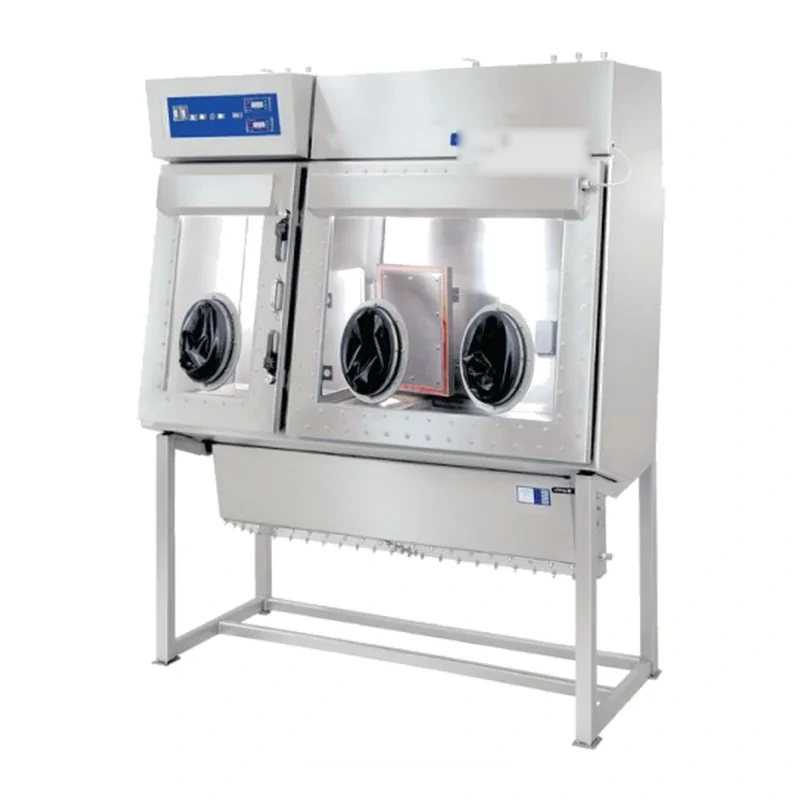
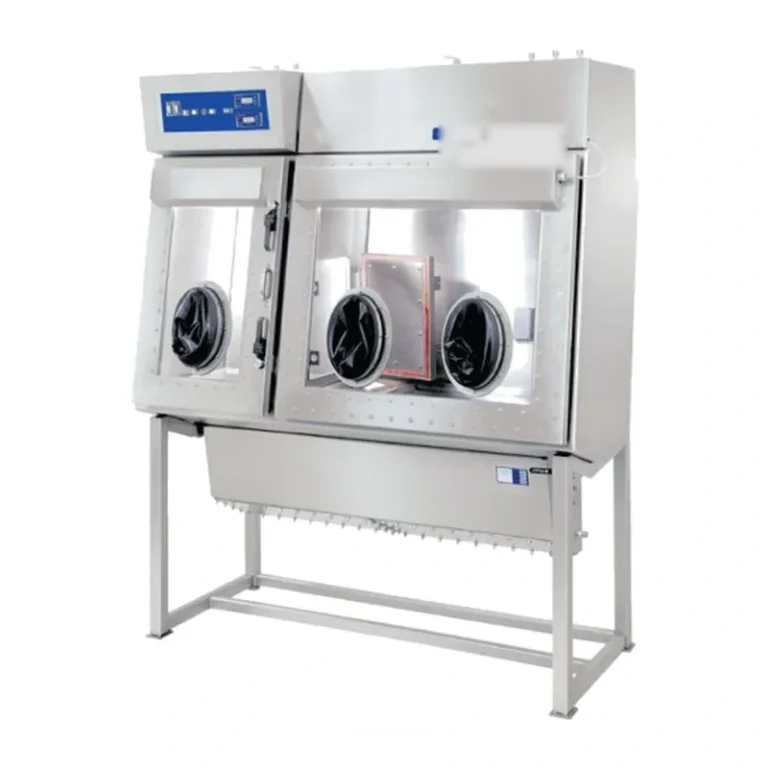
A Class III cabinet is not a cabinet in the sense the rest of this catalogue uses the word. It is a sealed, gas-tight glovebox held at negative pressure, with ULPA-filtered supply and exhaust, and it is the only Class III configuration that keeps a BSL-4 agent away from the operator by a physical barrier rather than an air curtain. Everything is manipulated through arm-length gloves on a fixed port ring. Materials enter and leave through a double-door pass box that is interlocked so both doors cannot open at once. The exhaust passes through two ULPA filters in series before the duct. Because the unit is built to order, the specification conversation matters more than the datasheet: glove port size and count, pass box volume, decontamination method, and the room interface all change the design. WSHLab builds 1100 mm and 1500 mm working widths as standard and takes the rest as a project.
- 1Products
- 0Direct categories
- Technical support
-
WSHLab Class III Biosafety Glovebox
- Containment class
- Class III gas-tight glovebox
- Working widths
- 1100 mm, 1500 mm
- External dimensions
- 1540-1790 × 880 × 2000-2080 mm (W × D × H)
- Internal dimensions
- 910-1165 × 650 × 660 mm (W × D × H)
Price on request
TECHNICAL DATA
Class III glovebox architecture
A welded gas-tight shell, negative pressure, glove ports and a double-door pass box. Supply and exhaust air pass through ULPA filters, with two stages on the exhaust.
Class III Biosafety Cabinets
View ProductWSHLab Class III Biosafety Glovebox
- Containment class
- Class III gas-tight glovebox
- Working widths
- 1100 mm, 1500 mm
- External dimensions
- 1540-1790 × 880 × 2000-2080 mm (W × D × H)
- Internal dimensions
- 910-1165 × 650 × 660 mm (W × D × H)
- Pass box
- 575 × 495 × 425 mm external; 430 × 355 × 330 mm internal
- Glove ports
- 8 in or 10 in ring, count to specification
- Filter
- Two ULPA U15 stages in series on exhaust
- Pressure
- Negative to room, monitored with alarm
- Power
- 1200-1300 VA plus 500 W socket load
- Noise
- ≤65 dB(A)
- Illumination
- ≥1000 lx
- Decontamination
- Formaldehyde or VHP; UV lamp for surfaces
- Width
- 4 ft / 1.2 m · 5 ft / 1.5 m
- Electrical
- 230V
- Performance Standard
- CE · EN-12469
- Application
- Multi-purpose
- Control System
- Pressure Sensor
Applications
Where a Class III cabinet is used
High-consequence agents and materials that must not escape.
Highly hazardous powder handling
Aerosol-generating procedures with risk group 4 agents
Containment of unknown or mixed biological material
PERFORMANCE & SELECTION
What makes it Class III
Gas-tight construction, negative pressure, glove ports and a double-door pass box. Every one of those is a containment barrier, and every one is tested before shipment.
- Gas-tight welded body, leak-tested to the agreed rate
- Negative pressure maintained by the exhaust blower
- Double-door interlocked pass box
- Two ULPA filters in series on the exhaust

CONFIGURATION & COMPATIBILITY
Working inside a glovebox
Reach, not airflow, limits you. Port spacing and glove size decide how much of the work zone you can actually use.
- Glove port ring, 8 in or 10 in, sized to the operator
- Work surface height 750 mm for seated operation
- Internal 304 stainless steel, coved corners, no crevices
- UV lamp for surface decontamination between sessions

IDENTIFICATION & TRACEABILITY
Clear Product Identification & Specification
Product names, model numbers, SKUs and option identifiers keep quotations, orders and internal records aligned.
- Product and model identification
- Option-specific SKU information
- Consistent quotation specifications
PRODUCT IDENTIFICATIONClass III Biosafety Cabinets
- Catalog
- Safety & compliance
- Products
- 1
- Selection
- Specification-led
Traceability
Documentation for a containment facility
A glovebox is part of a facility qualification, so the paperwork is part of the product.
- Design qualification and drawing set
- Pressure decay leak test report
- Filter integrity scan on both exhaust stages
- Installation and commissioning protocol
- Decontamination and filter-change procedure

Quality system
Choose the Right Class III Biosafety Cabinets Specification
Compare the specifications that determine application fit and acceptance.
Gas-tight glovebox
TYPICAL APPLICATIONSelection guidance for laboratory, quality and procurement teams.
QUALITY CHARACTERISTICSConfirm the exact requirement before orderingBSL-4 and high-consequence agents
TYPICAL APPLICATIONSelection guidance for laboratory, quality and procurement teams.
QUALITY CHARACTERISTICSConfirm the exact requirement before orderingDouble-door pass box
TYPICAL APPLICATIONSelection guidance for laboratory, quality and procurement teams.
QUALITY CHARACTERISTICSConfirm the exact requirement before orderingNegative pressure with ULPA exhaust
TYPICAL APPLICATIONSelection guidance for laboratory, quality and procurement teams.
QUALITY CHARACTERISTICSConfirm the exact requirement before orderingBuilt and tested to order
TYPICAL APPLICATIONSelection guidance for laboratory, quality and procurement teams.
QUALITY CHARACTERISTICSConfirm the exact requirement before orderingWhy WSHLab
Built around your protocol
Port count, pass box size and decontamination method are project decisions, not catalogue options. We design the unit around the work you need to do inside it.
Gas-tight welded 304 stainless steel shell
Double-door interlocked pass box
Two ULPA filters in series on exhaust
Negative pressure with alarm and backup blower option
UV surface decontamination
Leak test and filter scan before shipment
OPTIONS & SPECIFICATIONS
Class III Biosafety Cabinets Options & Specifications
Choose the format that suits your application, workload and handling requirements.
Gas-tight glovebox
BSL-4 and high-consequence agents
Double-door pass box
Negative pressure with ULPA exhaust
Built and tested to order
| Type | Capacity / Option | Material / Specification | Suitable Application | Storage / Handling |
|---|---|---|---|---|
| Gas-tight glovebox | By selected product | Product-specific configuration | Confirm with our team | Follow product guidance |
| BSL-4 and high-consequence agents | By selected product | Product-specific configuration | Confirm with our team | Follow product guidance |
| Double-door pass box | By selected product | Product-specific configuration | Confirm with our team | Follow product guidance |
| Negative pressure with ULPA exhaust | By selected product | Product-specific configuration | Confirm with our team | Follow product guidance |
| Built and tested to order | By selected product | Product-specific configuration | Confirm with our team | Follow product guidance |
Delivery and site
Class III Biosafety Cabinets Handling & Care Guide
Follow the product manual and site procedures for safe installation, use and maintenance.
- 01
Check Product & Accessories
Confirm model, options and supplied components.
- 02
Review Product Documentation
Read installation and safety instructions before use.
- 03
Prepare the Working Environment
Confirm space, utilities and operating conditions.
- 04
Plan Routine Care
Follow cleaning, inspection and maintenance guidance.

RECOMMENDATIONS
Related Products
Products frequently compared within this catalog.
GALLERY
Applications & Facilities Gallery
VIDEOS
Manufacturing & Quality Process
Category video library
Add category-specific video covers, titles, durations and video URLs in the Videos ACF section.
QUESTIONS & ANSWERS
Class III Biosafety Cabinets: frequently asked questions
The questions buyers ask most often when specifying Class III Biosafety Cabinets, answered by our technical team.
Do I need a Class III cabinet or a Class II in a suit laboratory?
Class III is specified where the agent is BSL-4 or where a suit laboratory is not available. It gives a physical barrier instead of relying on the operator's suit and the room air balance.
Can a Class III cabinet be installed in an existing BSL-3 room?
Yes, provided the room can take the duct and the make-up air, and the floor can carry the weight. The cabinet is negative to the room, so the room pressure strategy does not change.
GET A QUOTATION
Start a Class III project
Send the agent, the protocol and the room drawing. We will come back with a layout, a containment specification and a delivery schedule.