One cabinet, two exhaust modes
Class II Type C1 Biosafety Cabinets
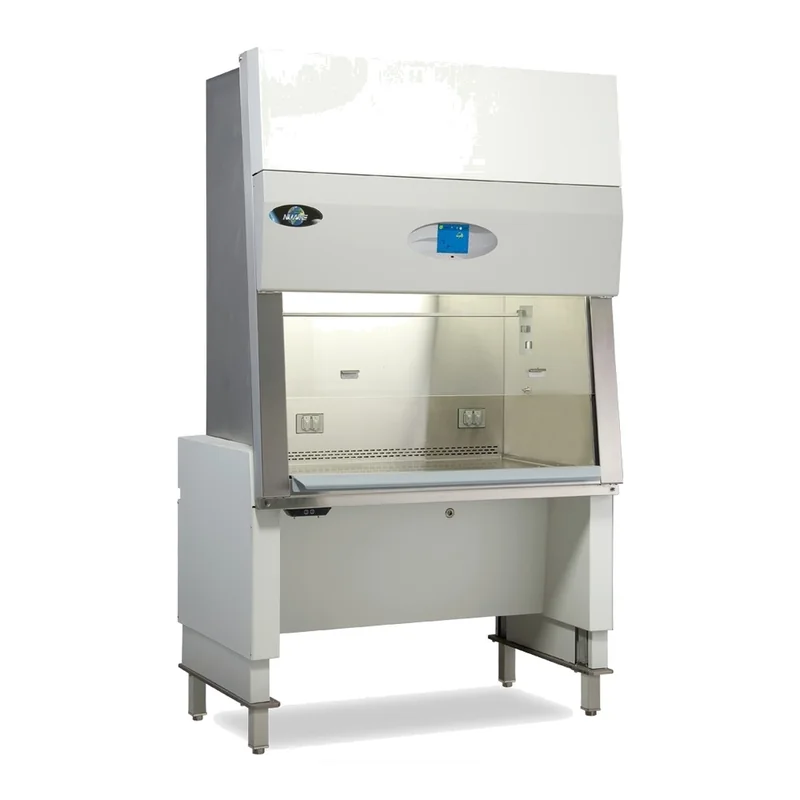
A C1 cabinet is a B2 cabinet that can be run in recirculating mode when the work is purely biological. The duct is installed once; a damper and control logic switch the cabinet between A2 behaviour (30% exhaust) and B2 behaviour (100% exhaust) as the protocol changes. It suits core facilities and multi-user laboratories where one week is cell culture and the next is sample preparation with solvents, and where buying and finding room for two cabinets is not realistic. The trade-off is mechanical complexity: there is a damper, a mode interlock and a control system that has to be certified in both configurations. WSHLab supplies the C1 with a pressure sensor, a mode interlock that prevents the sash opening in the wrong configuration, and a single certification covering both modes.
- 1Products
- 0Direct categories
- Technical support
-
WSHLab C1 Convertible Biosafety Cabinet
- Airflow class
- Class II Type C1 — convertible A2 / B2
- Modes
- A2: 30% exhaust, 70% recirculation; B2: 100% exhaust
- Downflow velocity
- 0.33 ± 0.025 m/s
- Inflow velocity
- 0.53 ± 0.025 m/s
Price on request
TECHNICAL DATA
C1 convertible architecture
A single duct, a motorised damper and a pressure sensor move the cabinet between recirculating and total exhaust operation without changing the filters or the work zone.
Class II Type C1 Biosafety Cabinets
View ProductWSHLab C1 Convertible Biosafety Cabinet
- Airflow class
- Class II Type C1 — convertible A2 / B2
- Modes
- A2: 30% exhaust, 70% recirculation; B2: 100% exhaust
- Downflow velocity
- 0.33 ± 0.025 m/s
- Inflow velocity
- 0.53 ± 0.025 m/s
- Exhaust volume
- 1400 m³/h in B2 mode
- Filter
- ULPA U15, 99.9995% at 0.12 µm
- Working width
- 4 ft / 1.2 m
- External dimensions
- 1300 × 800 × 2250 mm (W × D × H)
- Internal dimensions
- 1150 × 600 × 660 mm (W × D × H)
- Power
- 1800 VA maximum, 230V
- Noise
- ≤65 dB(A)
- Certification
- CE, UKCA, EN 12469, certified in both modes
- Width
- 4 ft / 1.2 m
- Work Access Opening
- 8 in / 203 mm
- Electrical
- 230V
- Performance Standard
- CE · EN-12469 · UKCA
- Application
- Multi-purpose
- Control System
- Pressure Sensor
Applications
Typical C1 applications
Programmes that change between biology and chemistry.
Contract research with rotating protocols
Method development and validation
Teaching laboratories with a chemistry module
PERFORMANCE & SELECTION
How the two modes differ
In A2 mode the exhaust damper is closed to 30% and most of the air recirculates. In B2 mode the damper opens fully and every cubic metre goes to the duct.
- A2 mode — 30% exhaust, 70% recirculation, lowest running cost
- B2 mode — 100% exhaust, no recirculation
- Mode interlock prevents a chemical protocol being run in A2 mode
- Duct sized for the B2 mode volume

CONFIGURATION & COMPATIBILITY
Who should buy a C1
Core facilities, teaching laboratories and contract research organisations with a mixed portfolio get the most from a convertible cabinet.
- Multi-user core facilities
- Contract research with changing protocols
- Laboratories planning a chemistry capability later
- Sites where a second duct run is not affordable

IDENTIFICATION & TRACEABILITY
Clear Product Identification & Specification
Product names, model numbers, SKUs and option identifiers keep quotations, orders and internal records aligned.
- Product and model identification
- Option-specific SKU information
- Consistent quotation specifications
PRODUCT IDENTIFICATIONClass II Type C1 Biosafety Cabinets
- Catalog
- Safety & compliance
- Products
- 1
- Selection
- Specification-led
Traceability
Traceable Supply & Quality Inspection
Documentation and inspection requirements are confirmed against the selected product and order.
- Product identification records
- Pre-delivery checks
- Documents available on request

Quality system
Choose the Right Class II Type C1 Biosafety Cabinets Specification
Compare the specifications that determine application fit and acceptance.
Switchable A2 / B2 operation
TYPICAL APPLICATIONSelection guidance for laboratory, quality and procurement teams.
QUALITY CHARACTERISTICSConfirm the exact requirement before orderingMixed research programmes
TYPICAL APPLICATIONSelection guidance for laboratory, quality and procurement teams.
QUALITY CHARACTERISTICSConfirm the exact requirement before orderingDuct installed once
TYPICAL APPLICATIONSelection guidance for laboratory, quality and procurement teams.
QUALITY CHARACTERISTICSConfirm the exact requirement before orderingPressure-based control
TYPICAL APPLICATIONSelection guidance for laboratory, quality and procurement teams.
QUALITY CHARACTERISTICSConfirm the exact requirement before orderingLower cost than two cabinets
TYPICAL APPLICATIONSelection guidance for laboratory, quality and procurement teams.
QUALITY CHARACTERISTICSConfirm the exact requirement before orderingWhy WSHLab
Why a convertible cabinet pays back
One footprint, one duct, two containment modes — cheaper than two cabinets and easier to schedule than a shared facility.
A2 and B2 modes on one cabinet
Mode interlock with sash protection
Pressure sensor with airflow alarm
ULPA U15 supply and exhaust filters
Single certification covering both modes
OPTIONS & SPECIFICATIONS
Class II Type C1 Biosafety Cabinets Options & Specifications
Choose the format that suits your application, workload and handling requirements.
Switchable A2 / B2 operation
Mixed research programmes
Duct installed once
Pressure-based control
Lower cost than two cabinets
| Type | Capacity / Option | Material / Specification | Suitable Application | Storage / Handling |
|---|---|---|---|---|
| Switchable A2 / B2 operation | By selected product | Product-specific configuration | Confirm with our team | Follow product guidance |
| Mixed research programmes | By selected product | Product-specific configuration | Confirm with our team | Follow product guidance |
| Duct installed once | By selected product | Product-specific configuration | Confirm with our team | Follow product guidance |
| Pressure-based control | By selected product | Product-specific configuration | Confirm with our team | Follow product guidance |
| Lower cost than two cabinets | By selected product | Product-specific configuration | Confirm with our team | Follow product guidance |
Delivery and site
Class II Type C1 Biosafety Cabinets Handling & Care Guide
Follow the product manual and site procedures for safe installation, use and maintenance.
- 01
Check Product & Accessories
Confirm model, options and supplied components.
- 02
Review Product Documentation
Read installation and safety instructions before use.
- 03
Prepare the Working Environment
Confirm space, utilities and operating conditions.
- 04
Plan Routine Care
Follow cleaning, inspection and maintenance guidance.

RECOMMENDATIONS
Related Products
Products frequently compared within this catalog.
GALLERY
Applications & Facilities Gallery
VIDEOS
Manufacturing & Quality Process
Category video library
Add category-specific video covers, titles, durations and video URLs in the Videos ACF section.
QUESTIONS & ANSWERS
Class II Type C1 Biosafety Cabinets: frequently asked questions
The questions buyers ask most often when specifying Class II Type C1 Biosafety Cabinets, answered by our technical team.
Is a C1 cabinet as safe as a B2 in total exhaust mode?
Yes, when it is correctly installed and certified in that mode. The containment physics are the same; the difference is the damper and interlock that allow the second mode.
Can I change mode myself?
The mode change is a controlled procedure, not a switch on the front panel during work. It is performed with the cabinet empty, and your SOP should record which mode the cabinet is in.
GET A QUOTATION
Discuss a convertible installation
Tell us the two protocols and the duct you can provide. We will confirm whether C1 or a dedicated A2 plus B2 pair is the better answer.