Description
Overview
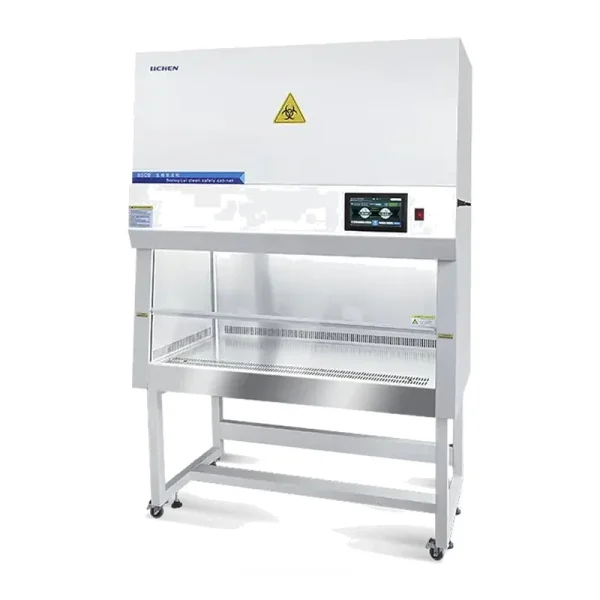
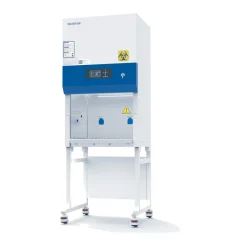
Most laboratories do not need a monitored cabinet. They need a cabinet that holds 0.33 m/s downflow, keeps the work zone at ISO Class 4, and does it every day for ten years without a control system that asks for attention. That is what the A2 Standard is: the same body, filters and blower as our monitored cabinets, with a single airflow sensor and a manual sash.
You get the containment without the instrumentation overhead. The sensor watches downflow and alarms if the filter loads or the blower drifts; the sash is counterbalanced and lifts to a fixed working height, so there is nothing to calibrate and nothing to train beyond normal good practice.
It is the cabinet we ship most often for tissue culture, media preparation and microbiology, in 3 ft and 4 ft widths for a single operator and 6 ft for two.
Key features
- Single airflow sensor, honest alarms. The sensor monitors downflow and triggers audible and visual alarms on drift or filter load. No calibration routine, no software to update.
- ULPA filtration, not just HEPA. Supply and exhaust filters are ULPA U15 rated 99.9995% at 0.12 µm, which holds the work zone at ISO Class 4 rather than the ISO Class 5 a H14 filter gives you.
- One-piece 304 stainless work zone. Coved corners and no fasteners in the airflow path. A spill can be cleaned in one pass instead of chasing it out of a seam.
- Manual sash, counterbalanced. Set the working height once and it stays there. Fewer mechanisms means fewer service calls and nothing to fail during a contamination event.
Specifications
| Airflow class | Class II Type A2 — 30% exhausted, 70% recirculated |
|---|---|
| Downflow velocity | 0.33 ± 0.025 m/s |
| Inflow velocity | 0.53 ± 0.025 m/s |
| Filter | ULPA U15, 99.9995% at 0.12 µm, supply and exhaust |
| Work zone cleanliness | ISO Class 4 (Class 10) at the tested sash height |
| Working widths | 3 ft / 0.9 m, 4 ft / 1.2 m, 5 ft / 1.5 m, 6 ft / 1.8 m |
| External dimensions | 1100-1800 × 775 × 2200 mm (W × D × H) |
| Internal dimensions | 940-1625 × 600 × 660 mm (W × D × H) |
| Exhaust volume | 380-620 m³/h depending on width |
| Power | 1600 VA maximum, 230V or 115V single phase |
| Noise | ≤65 dB(A) |
| Illumination | ≥1000 lx at the work surface |
| Work surface height | 770 mm from floor |
| Electrical safety | IEC 61010-1; EMC IEC 61326 |
| Certification | NSF/ANSI 49 or EN 12469, CE / UKCA marking |
Where you would install it
- Cell and tissue culture. Routine passaging, media preparation and bottle work at 0.33 m/s downflow.
- Microbiology. Plating and sample processing where product protection matters but no volatiles are used.
- Teaching laboratories. A cabinet students can be trained on without a control system that invites adjustment.
Frequently asked questions
Do I need the monitored version instead?
If your auditor asks for a traceable airflow record — USP 797 compounding, for example — take the Premium. For cell culture and microbiology, the single sensor is enough.
Why ULPA rather than HEPA?
A U15 filter removes 99.9995% of particles at 0.12 µm against 99.995% for H14, which is what keeps the work zone at ISO Class 4 instead of ISO Class 5.
Reviews
There are no reviews yet.