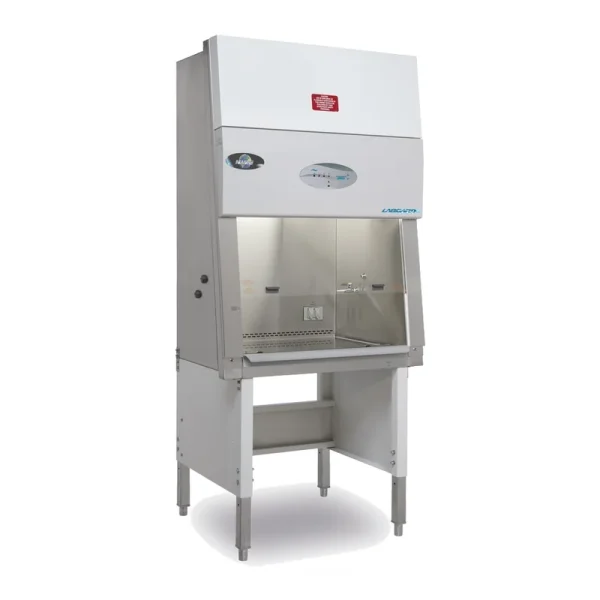
Description
Overview
A Class I cabinet protects you and the room, not the sample. Air is drawn in through the open front, passes once over the work surface and leaves through a HEPA filter, either to the room or to a duct. Nothing is recirculated, so nothing accumulates.
That makes it the right choice for low-risk work where you need containment and a clean exhaust but do not need a sterile work zone above the bench: weighing powders, handling non-sterile samples, dissecting, or working with odorous reagents that must leave the room filtered.
You get the same 304 stainless work zone, the same filter grade and the same factory airflow report as our Class II cabinets, with a simpler air path that costs less to buy, less to duct and less to certify. If your protocol needs product protection as well, move to Type A2.
Key features
- Single-pass airflow, nothing recirculated. 100% of the air leaves through the exhaust filter. Volatile odours, aerosols and fumes do not build up in the cabinet or return to your work zone.
- 0.7 m/s inflow at the sash opening. The inward velocity that holds containment against arm movement and room draughts, verified at the tested opening height and recorded on the factory report.
- H14 HEPA exhaust filtration. 99.995% at MPPS on the exhaust path, so particles and bioaerosols are removed before the air reaches the duct or the room.
- Ducted or ductless-to-room configuration. Order it with a canopy for hard ducting, or with a filtered discharge when recirculation to the room is acceptable for your risk assessment.
Specifications
| Airflow class | Class I — open front, single-pass, 100% exhaust |
|---|---|
| Inflow velocity | 0.7 m/s (EN 12469) / 0.38 m/s minimum (NSF/ANSI 49) |
| Filter | HEPA H14, 99.995% at MPPS, exhaust path |
| Working widths | 3 ft / 0.9 m, 4 ft / 1.2 m |
| External dimensions | 1000-1300 × 750 × 1250 mm (W × D × H, cabinet only) |
| Internal dimensions | 900-1200 × 600 × 700 mm (W × D × H) |
| Exhaust connection | 150 mm or 200 mm collar, hard duct recommended |
| Work zone | 304 stainless steel, coved corners |
| Power | 500 VA maximum, 230V or 115V single phase |
| Noise | ≤65 dB(A) |
| Illumination | ≥800 lx at the work surface |
| Electrical safety | IEC 61010-1; EMC IEC 61326 |
| Certification | NSF/ANSI 49 Class I or EN 12469, CE / UKCA marking |
Where you would install it
- Powder weighing. Containment and filtered exhaust where the sample itself does not need sterility.
- Non-sterile sample handling. Dissection, sampling and processing at containment level 2.
- Odorous or irritating reagents. Single-pass exhaust keeps fumes out of the room air.
Frequently asked questions
Is a Class I cabinet still worth buying?
When you need containment and clean exhaust but not a sterile work zone, yes. It costs less than a Class II, needs a simpler duct run, and is easier to certify.
Can I use a Class I for cell culture?
No. A Class I gives no product protection, so an open culture dish sits in unfiltered room air. Use a Class II Type A2 for cell work.
Does it have to be ducted?
Not always. A filtered discharge back to the room is acceptable where your risk assessment allows it, but a hard duct is the safer default for chemical work.
Reviews
There are no reviews yet.