Description
Overview
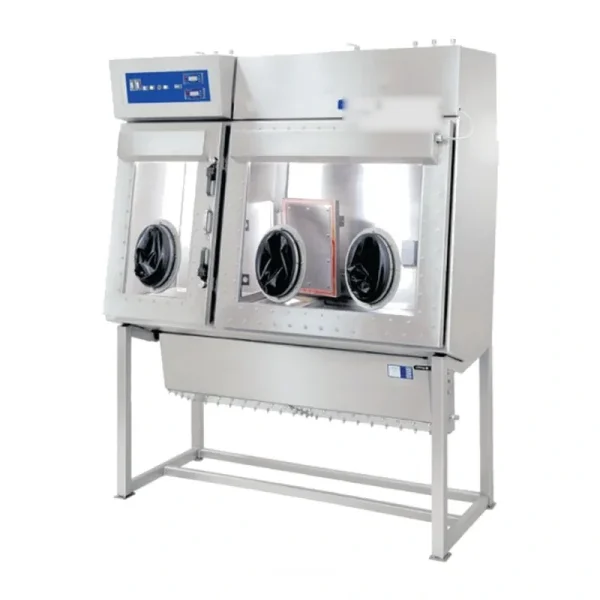
Class III containment does not depend on airflow behaving. The operator is separated from the agent by a welded stainless shell, a glove port and a sealed pass box, and the interior is held at negative pressure so that any leak moves inward.
Materials enter and leave through a double-door pass box with an interlock that prevents both doors opening at once. Exhaust air passes through two ULPA filters in series before it reaches the duct, and the filter change is done through bag-out ports on the contaminated side.
WSHLab builds 1100 mm and 1500 mm working widths as standard. Port count, glove size, pass box volume and decontamination method are project decisions, and we quote them against your protocol rather than from a catalogue.
Key features
- Gas-tight welded shell. The body is welded and leak-tested to an agreed pressure-decay rate before shipment, not sealed with gaskets alone.
- Double-door interlocked pass box. Both doors cannot open at the same time, so the work zone is never open to the room.
- Two ULPA filters in series. Exhaust air passes through two U15 filters before the duct, with bag-out access for each stage.
- Negative pressure with alarm. Pressure is monitored continuously; a blower fault alarms before containment is affected.
Specifications
| Containment class | Class III gas-tight glovebox |
|---|---|
| Working widths | 1100 mm, 1500 mm |
| External dimensions | 1540-1790 × 880 × 2000-2080 mm (W × D × H) |
| Internal dimensions | 910-1165 × 650 × 660 mm (W × D × H) |
| Pass box | 575 × 495 × 425 mm external; 430 × 355 × 330 mm internal |
| Glove ports | 8 in or 10 in ring, count to specification |
| Filter | Two ULPA U15 stages in series on exhaust |
| Pressure | Negative to room, monitored with alarm |
| Power | 1200-1300 VA plus 500 W socket load |
| Noise | ≤65 dB(A) |
| Illumination | ≥1000 lx |
| Decontamination | Formaldehyde or VHP; UV lamp for surfaces |
Where you would install it
- BSL-4 laboratories. Agent manipulation behind a physical barrier rather than a suit.
- High-consequence work. Procedures where an aerosol release cannot be tolerated.
- Unknown material. Containment where the agent has not yet been characterised.
Frequently asked questions
Does a Class III cabinet replace a suit laboratory?
It provides a physical barrier that a suit laboratory does not, but facility requirements differ by country. We design to the containment level your authority specifies.
How long does a build take?
A Class III unit is built to order. Expect a longer lead time than a catalogue cabinet, and plan the room, duct and decontamination procedure in parallel.
Reviews
There are no reviews yet.