Description
Overview
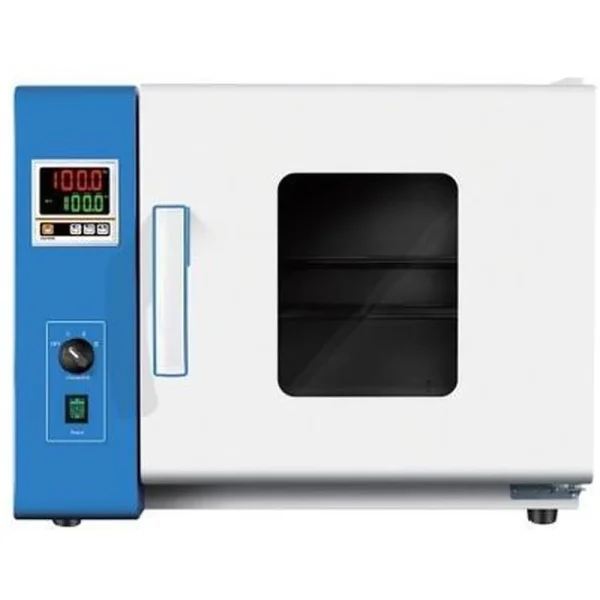
The RDO is the benchtop lab oven you specify when the load is real but the bench is finite: a compact forced air drying oven from 45L to 245L that holds RT+10°C to 300°C with PID control on a PT100 sensor. Horizontal airflow from a low-noise blower reaches every shelf, so glassware on the top tray dries at the same rate as samples on the bottom.
You choose the configuration to match the work. Base models pair a 201 stainless or galvanised chamber with an LCD controller; upgraded C-series models bring a 304 stainless interior, 10-speed adjustable airflow, over-temperature protection and a safety lock. Every version carries the double-layer tempered glass window and the silicone door seal that survives years of continuous high-temperature duty.
It is the tabletop oven that ends up doing everything: a glassware drying oven after the washer, a sample drying oven for QC, a small drying oven for pilot batches. If your loads outgrow the bench, the RGL vertical series puts the same convection loop on the floor.
Key features
- Horizontal forced air circulation. low-noise blower drives hot air across every shelf; ±1°C fluctuation at 100°C, ±2.5% uniformity across the chamber
- PID control with self-tuning. timer, over-temperature alarm and self-tuning on every model; 0.1°C resolution
- Double-layer tempered glass window. watch the load without opening the door and losing the uniformity envelope
- Silicone door seal. rated for continuous high-temperature operation, replacing the baked-on leaks of cheap gaskets
- Stainless chamber with rounded corners. 201 stainless standard, 304 stainless on C-series; wipes clean between loads
- 10-speed adjustable airflow. C-series tunes circulation to the load — gentle for powders, maximum for glassware
- Over-temperature protection and safety lock. independent protection circuit on upgraded models guards unattended runs
Specifications
| Model range | RDO-9042 / 9070 / 9136 / 9210 / 9245 (A/B/C configurations) |
|---|---|
| Capacity options | 45L (1000W) · 70L (1500W) · 136L (2000W) · 210L (2000W) · 245L (3000W) |
| Temperature range | RT+10°C to 300°C, resolution 0.1°C |
| Fluctuation | ±1°C at 100°C; uniformity ±2.5% |
| Controller | LCD (base) / LED digital (C-series) / touchscreen option, PID with timer, over-temp alarm, self-tuning |
| Sensor | PT100 class A |
| Chamber | A: 201 stainless / B: galvanised / C: SUS304 stainless, rounded corners |
| Interior dimensions (W×D×H) | 45L 350×350×350 · 70L 350×450×450 · 136L 450×550×550 · 210L 500×600×700 · 245L 500×700×700 mm |
| Exterior dimensions (W×D×H) | 45L 520×660×530 · 70L 510×750×620 · 136L 620×860×715 · 210L 680×910×880 · 245L 670×1000×880 mm |
| Shelves (standard / max) | 45L 2/4 · 70L 2/6 · 136L 2/6 · 210L 2/10 · 245L 2/10 |
| Power | 220V 50/60Hz; 110V available on request |
| Certification | CE marked; built under ISO 9001 |
Where you would install it
- Glassware drying. post-washer drying of beakers, flasks and pipettes without water spots
- Sample drying. QC and R&D samples that need reproducible, logged thermal treatment
- Powder and granulate drying. gentle airflow settings on C-series keep light powders in place
- General lab drying and baking. the everyday benchtop oven for everything else the lab throws at it
Frequently asked questions
What sizes are available?
45L, 70L, 136L, 210L and 245L, each with LED digital or touchscreen control — ten variants in total. Interior dimensions for each size are in the specifications table.
Is the chamber 304 stainless?
Yes — the C-series has a SUS304 stainless chamber with rounded corners as standard. Base models offer 201 stainless or galvanised interiors.
What voltage does it need?
220V 50/60Hz as standard, with 110V versions available for North American labs. The 245L model draws 3000W — check the circuit before it moves in.
Does it have a timer?
Yes — every controller includes a timer with over-temperature alarm and PID self-tuning, on both LED and touchscreen models.
Can I get a glass viewing window?
Yes — a double-layer tempered glass window is standard on all models, so you can observe the load without breaking the uniformity envelope.
Reviews
There are no reviews yet.